-
首页
-

备份栏目
sidenav header background国家发展研究院理事会
北大公共政策国际论坛
校友
互联网金融研究中心年会
中国健康与养老追踪调查
捐赠
土地制度研究
捐赠
NSD实践调研奖学金
中国经济展望论坛
新结构经济学专项研究基金
研讨会
朗润-龙信创新指数
学术交流
课题
老龄中心讲座
交流信息
项目申请
中国线上消费品牌指数
北大汇丰经济论坛
博士后信息
金融论坛
CCER论坛
国内合作
国家发展研究院专题报告会
经济理论与政策研讨讲座
人文与社会跨学科学术讲座
朗润-新结构
教育部基地联谊会
DPS
【朗润·格政】学术论坛
专著
CEO经济观察报告会
Partnering with China for a Better Shared Future
发布日期:2019-03-22 12:40
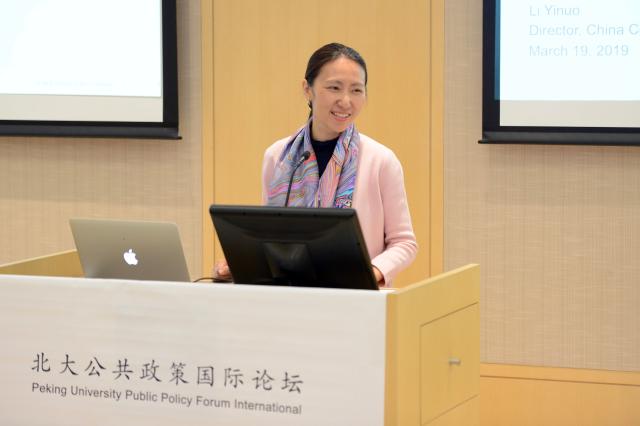
On March 19, 2019, Dr. Yinuo Li, Director of China Country Office at Bill & Melinda Gates Foundation, delivered a speech to students of the Institute of South-South Cooperation and Development (ISSCAD) at Peking University Public Policy Forum International. With more than a decade of partnership with China’s public, private, and non-profit sectors, Bill & Melinda Gates Foundation has helped tackle challenges in public health and development both in China and globally. In the process, the organization has noticed that agricultural development and health system strengthening are the keys for China’s continuous growth and looks forward to applying Chinese experience to other developing countries. Therefore, with “Partnering with China for a Better Shared Future” as the topic of the talk, Dr. Li introduces the key learnings from China’s agricultural development and health system strengthening to show that China’s experience is applicable to countries with similar economic and social development stages.
Dr. Li believes that agriculture development is a significant drive for a nation’s overall development and China’s success in agriculture development is reproducible in other developing countries. In the past 40 years, China has witnessed a remarkable growth in its agriculture. Although China and African countries started at similar levels, Chinese agricultural output has increased by 12% p.a. since 1975 while Africa has grown at 2.8% p.a., and the agriculture output in China is currently 2.7 times as that of in Africa. Similar gap also exists in the increase of agricultural productivity. The success in agriculture transformation has benefitted China in many aspects. It improves the food system and consequently contributes to better health and nutrition with the protein intake doubled in the past four decades and the proportion of undernourished population reduced from 24.3% to 9.3%. It also significantly increases rural income and alleviates poverty in China as poverty population has reduced by 87.6%. Higher productivity in agriculture has encouraged laborers to work in other sectors and thus has stimulated economic growth. According to her experience and research, Dr. Li concludes that system and strategy, production structure, infrastructure, technology, and market are the five main initiatives that boost the agricultural transformation in China. She sees in China’s agricultural development a model for other developing countries with similar conditions and takes Vietnam as an example to demonstrate the feasibility of achieving agricultural growth by learning from Chinese experience.
According to Dr. Li, the adoption of certain Chinese approaches to enhance the health system can support the progress in public health among other developing countries. She takes China’s 60-year anti-malaria campaign to illustrate this point. While the reduction of worldwide malaria deaths slows down in the past three years, China reported no indigenous cases of malaria in 2017 and is on its target of “malaria-free” by 2020. After analyzing China’s integrated anti-malaria program and introducing the key measures, Dr. Li calls attention to China’s 1-3-7 response strategy as an approach applicable to other countries facing the same challenge. Implemented in 2012, China’s 1-3-7 strategy requires counties to report malaria cases within 1 day, their confirmation and investigation within 3 days, and response to prevent further transmission within 7 days. This strategy has been a major factor in Chinas’ success in combating malaria and now is written in WHO’s guidebook for malaria elimination. Dr. Li summarizes the key learnings of China’s anti-malaria campaign as central leadership, community mobilization, capacity building, and coordination mechanism and again emphasizes that China’s experience can be applied to foreign countries with similar economic and social status.
Inspired by the informative presentation, students asked questions about the scale of China’s organic agriculture, the foundation’s efforts to ensure appropriate use of grants, and its investment in infrastructure. Dr. Li gave concise answers to the questions and the talk ends with the expectation for a better future through the partnership between China and other developing countries.
Prof. FU Jun, Academic Dean of ISSCAD hosted the event.
国家发展研究院官方微信
Copyright© 1994-2012 北京大学 国家发展研究院 版权所有, 京ICP备05065075号-1
保留所有权利,不经允许请勿挪用
-
首页
-
sidenav background
备份栏目
sidenav header backgroundPartnering with China for a Better Shared Future
发布日期:2019-03-22 12:40
On March 19, 2019, Dr. Yinuo Li, Director of China Country Office at Bill & Melinda Gates Foundation, delivered a speech to students of the Institute of South-South Cooperation and Development (ISSCAD) at Peking University Public Policy Forum International. With more than a decade of partnership with China’s public, private, and non-profit sectors, Bill & Melinda Gates Foundation has helped tackle challenges in public health and development both in China and globally. In the process, the organization has noticed that agricultural development and health system strengthening are the keys for China’s continuous growth and looks forward to applying Chinese experience to other developing countries. Therefore, with “Partnering with China for a Better Shared Future” as the topic of the talk, Dr. Li introduces the key learnings from China’s agricultural development and health system strengthening to show that China’s experience is applicable to countries with similar economic and social development stages.
Dr. Li believes that agriculture development is a significant drive for a nation’s overall development and China’s success in agriculture development is reproducible in other developing countries. In the past 40 years, China has witnessed a remarkable growth in its agriculture. Although China and African countries started at similar levels, Chinese agricultural output has increased by 12% p.a. since 1975 while Africa has grown at 2.8% p.a., and the agriculture output in China is currently 2.7 times as that of in Africa. Similar gap also exists in the increase of agricultural productivity. The success in agriculture transformation has benefitted China in many aspects. It improves the food system and consequently contributes to better health and nutrition with the protein intake doubled in the past four decades and the proportion of undernourished population reduced from 24.3% to 9.3%. It also significantly increases rural income and alleviates poverty in China as poverty population has reduced by 87.6%. Higher productivity in agriculture has encouraged laborers to work in other sectors and thus has stimulated economic growth. According to her experience and research, Dr. Li concludes that system and strategy, production structure, infrastructure, technology, and market are the five main initiatives that boost the agricultural transformation in China. She sees in China’s agricultural development a model for other developing countries with similar conditions and takes Vietnam as an example to demonstrate the feasibility of achieving agricultural growth by learning from Chinese experience.
According to Dr. Li, the adoption of certain Chinese approaches to enhance the health system can support the progress in public health among other developing countries. She takes China’s 60-year anti-malaria campaign to illustrate this point. While the reduction of worldwide malaria deaths slows down in the past three years, China reported no indigenous cases of malaria in 2017 and is on its target of “malaria-free” by 2020. After analyzing China’s integrated anti-malaria program and introducing the key measures, Dr. Li calls attention to China’s 1-3-7 response strategy as an approach applicable to other countries facing the same challenge. Implemented in 2012, China’s 1-3-7 strategy requires counties to report malaria cases within 1 day, their confirmation and investigation within 3 days, and response to prevent further transmission within 7 days. This strategy has been a major factor in Chinas’ success in combating malaria and now is written in WHO’s guidebook for malaria elimination. Dr. Li summarizes the key learnings of China’s anti-malaria campaign as central leadership, community mobilization, capacity building, and coordination mechanism and again emphasizes that China’s experience can be applied to foreign countries with similar economic and social status.
Inspired by the informative presentation, students asked questions about the scale of China’s organic agriculture, the foundation’s efforts to ensure appropriate use of grants, and its investment in infrastructure. Dr. Li gave concise answers to the questions and the talk ends with the expectation for a better future through the partnership between China and other developing countries.
Prof. FU Jun, Academic Dean of ISSCAD hosted the event.
 访问学者申请
 EMAIL
EMAIL 北京大学
北京大学 ENGLISH